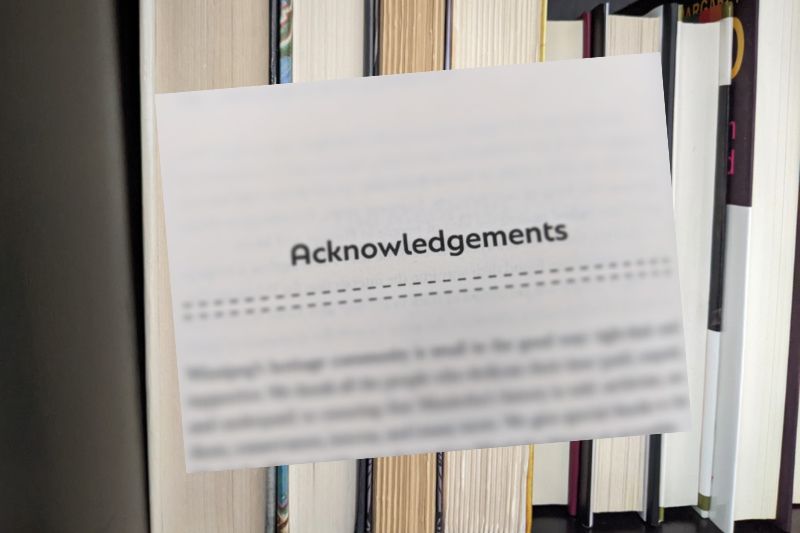
The acknowledgements page (or pages), which usually appears at the back of the book, but can occasionally be found at the front, is a spot for the author to thank those who had a role in the creation of the book. Sometimes they also include a variety of author notes that give backstory to the creation of the book and provide insight into the plot and characters.
For many years, I paid little or no attention to the acknowledgements section, or even special author notes. That is no longer the case. Reading the acknowledgements is part of reading the book for me. I gain greater appreciation for both the book and its author(s).
In its simplest form, the acknowledgements section is a short paragraph listing people the author wishes to thank. But even that simple paragraph may be an interesting read. It is common for an author to say something to the effect “all mistakes are mine” after completing their thank-yous. Kate Atkinson, in her book Started Early, Took My Dog begins her short paragraph of acknowledgements with the following, “All mistakes are mine, some deliberate. I have not necessarily kept to the truth.”
Acknowledgements, in the way they are worded and what is included, can give a sense of the author’s personality. The personalities of the authors of Portage and Main: How An Iconic Intersection Shaped Winnipeg’s History, Politics, and Urban Life come through strongly in their acknowledgements as does the comfortable bantering relationship between the two. Sabrina Janke thanks her mother for “not batting an eyelash when I decided to begin a history major with no broader career plans” and her siblings for “humbling me, at all times, whether I like it or not.” Alex Judge thanks her father and sisters, “ all of whom have indulged many history lectures disguised as ‘fun facts’.”
Sometimes, acknowledgements give a sense of how much and what type of research has gone into the book. Although the acknowledgements section in Started Early, Took My Dog is short (it covers only a fraction of one page), you still get a sense of that. It is a detective story. The acknowledgement list includes members of the police force.
Books where a lot of research is required, particularly historical fiction, will typically have longer acknowledgement sections. I am often impressed by the amount and types of research authors have done in order to give authenticity to their novel. They might note places in the book where this research was particularly relevant or where they deviated slightly from exact time lines or locales.
This section may go beyond acknowledgements and include notes about the development of the story and events featured in it. One of my favourite recently-read examples of this is from the book The Briar Club by Kate Quinn. She begins the section titled Author’s Notes with a warning for those who like to read the notes and acknowledgements before reading the book. She tells them to wait. The section gives too much of the story away.
She tells the fascinating story of how the book idea came to her and evolved. The book takes place in 1950s American during the height of the Cold War and the McCarthy era. She cites real-life events that inspired the stories in the book, some of which I knew, some of which were a bit of a surprise. The book features several women at an all-female boarding house. Quinn describes how real-life events or people inspired some aspects of those fictional women’s character or backstory.
In Finding Flora, which features women homesteaders and farmers in early 1900s Canada, author Elinor Florence provides historical background about real women homesteaders and farmers. It prompted me to dig a bit deeper into a history I knew nothing about. The notes in The Covenant of Water by Abraham Verghese provides, among other things, a bit more information about a medical condition running through the book, a condition that feels more like a superstition than a real illness during the reading.
So, if you are one of those readers who skips the acknowledgements, I encourage you to start reading them. It may increase your enjoyment of the book and appreciation for the author(s).
(NOTE: With the exception of Started Early, Took My Dog, which I read years ago, the books referenced here are all from the Top Picks From My 2025 Reading List.)
Be First to Comment